Wednesday, July 29, 2009

Tzatziki Sauce

Tzatziki Sauce

Greek style yogurt (16 oz.)
3 cloves garlic
1-2 cucumbers (skin on)
salt & pepper to taste
splash of olive oil
This sauce is just outstanding on everything! Take a container of Greek style yogurt -- no-fat, low-fat, it doesn't matter but it has to be thick. Grate 1-2 cukes on a box grater and then squeeze out all the water. Mince 3 cloves of garlic VERY fine. Stir cucumber and garlic into yogurt, add a splash of olive oil and a grind of black pepper. Dunk in vegetable of your choice, slather on toasted pita,

The Tomato Moment


By Nina

This, my CSA friends, is the tomato moment. All the staking and watering and sucker pinching has come to this. Say the names with me: Big Boy. Better Boy. Rutgers. Early Girl. Ramapo. Roma. Sungold. Celebrity. Lemon Boy. Brandywine.

I am the daughter of a woman whose idea of bliss is a sliced tomato sandwich on toast with mayonnaise. Yet I confess, I did not eat uncooked tomatoes until I was an adult. Now I am making up for the foolishness of my youth and finding as many reasons as possible to enjoy fresh vine ripe tomatoes.

This summer's best tomato moments have included a Sunday salad of yellow, red, cherry and green tomatoes, lightly dressed in olive oil and sprinkled with torn fresh basil leaves was a wonder. In Richmond, VA I had a cold soup of pureed tomatoes and watermelon, dressed a swirl of basil oil and sprinkled with feta cheese that was summer in a bowl. I'm trying like mad to recreate the recipe. I may just have to write to the restaurant and beg.

The NY Times had a great piece about Jersey tomatoes last year. In part it was a reaction to the glorification of so-called heirloom tomatoes. One grower in the story had this to say about heirlooms:

“Everyone was going gaga over them. My farmers were trying to grow them, and we’d walk out in the field and just see horticultural garbage,” said Mr. Rabin, a longtime agricultural extension agent with Rutgers University in New Brunswick, N.J. who works with about 800 growers around the state. “Every time it rained, they would crack open or turn into water bags. They burned in the sun or developed fungus you could taste,” he said. “It was painful to watch, and the yields were a nightmare.”

My feeling about heirloom tomatoes is mixed. My friend Fran and I sashayed over to the Peachtree Road Farmer's Market at the Cathedral of St. Phillip the other weekend and were enchanted by the funny shaped and multi-colored heirloom varieties. But whoa, they were selling for $6.00 a pound! Fran bought one gigundo tomato which became the centerpiece of her dinner. She said it was luscious, but I'm not sure she has recovered from the idea of a $6 tomato. I bought a half dozen green zebras, about $5 worth and thought they were great. But I don't think they're heirlooms, just a green tomato variety you don't see in the store.

Uncooked tomato sauce is how I celebrate the tomato moment. What you want are 3-5 big vine ripened, plump tomatoes of any variety you like. The more colors the better. Rough chop into 1/2" pieces with a serrated knife and dump into a big bowl. Leave on the skins, leave in the seeds. Add 2-3 large cloves of raw minced garlic. DO NOT USE THE STUFF FROM THE JAR! Use real cloves of garlic. Add at least a 1/2 cup of really good olive oil. Sprinkle with salt and many hearty twists of ground pepper. Add in some torn fresh basil leaves if you have them. No fresh basil? No matter. Now cook up a pound of pasta -- any shape you like (whole wheat is actually a good choice for this) and drain. While still hot, dump the pasta into the big bowl with the uncooked tomatoes and garlic. Toss gently and serve immediately.

Eat slowly with plenty of parmesan cheese and a big glass of wine. It does not get any better than this.

Tuesday, July 28, 2009

Tisha B'Av Pick Up

By Rabbi Mark Hurvitz

I’ve been fasting a good deal this past month. I’ve fasted to call attention to the situation in Darfur and also Gaza. This week, my CSA pick-up at the 14th street Y in Downtown Manhattan, occurs on the 9th of Av before sundown and the end of the fast, calling our attention to the destruction of the first and second Temples in Jerusalem and the Expulsion of the Jews from Spain (and other calamities). This year, the end of the fast coincides with my CSA pick-up. Can we use this time of commemorating the laying waste, to what was at one time glorious, to help us focus our regard more intently on the richness we have about us? Our classic sources (Talmud Bavli Berachot 17a) teach that fasting is compared to sacrifice: an offering up of our own blood and fat; the prophet Isaiah rhetorically asked us thousands of years ago (58:6-7): Is not this the fast that I have chosen? Is it not to deal your bread to the hungry, and that you bring the poor that are cast out to your house? When you see the naked, that you cover them, and that you hide not yourself from your own flesh? Here we are, even in this severe economic downturn “The Great Recession” still in the richest country in the world. Very few of us have direct contact with people who suffer malnutrition or hunger. Perhaps those who don’t face health risks by not eating can hold off on our own food and experience a bit of hunger. Tisha B'Av might be a time when many of us who usually experience plenitude will deny ourselves sustainable in recollection of the suffering and destruction the Jewish people have experienced. Many people in our community are also fasting to call attention to humanitarian crises around the world. We can even turn what we might have spent on our own food to contribute to those various agencies that work to prevent hunger such as Mazon (http://www.mazon.org). This is by no means the end of our work for justice, but one step towards calling attention to the ways in which our world, in ancient times and now, needs all our efforts in the process of tikkun, of repair. Rabbi Mark Hurvitz is a shareholder at the 14th Street Y in Downtown Manhattan Read more of the writings of Rabbi Mark Hurvitz on his blog (www.davka.org) or on Hazon’s blog The Jew and the Carrot (www.jcarrot.org).

Friday, July 24, 2009

The Kitchen as a Place of Perpetual Blessing

From Nada Chandler shareholder and member of the Steering Committee of Houston’s Tuv Ha’Aretz

Nada Chandler, shareholder from Houston, Texas reminds us that there are already long standing ways for women to bless the food they are preparing that are not within the traditional liturgy. I have just recently learned from Nada that many women may recite prayers called Tekhines. Tekhines are Jewish private devotions and prayers in Yiddish written by both women and men, but recited primarily by women. Nada has also told me that Tekhines have been a part of the Jewish tradition for at least 400 documented years and in today's world, women who recite Tekhines in their kitchen probably do not have to consult anything but their memory.
- Brooke Saias, Hazon’s Food Justice Coordinator

Rooted in our tradition over the centuries, women have recited the most basic “cooking” blessing, as they made their Challah:

May it be Your will, our God, the God of our Fathers, that You bless our dough, as You blessed the dough of our Mothers, Sarah, Rivkah, Rachel and Leah. And may we be blessed as in the verse: “You shall give the first yield of your dough to the kohen to make a blessing rest upon your home.” “May the pleasantness of the Lord our God be upon us; establish for us the work of our hands; establish the work of our hands.”

Women did not have to consult a siddur or an established liturgy as they cooked, they either, as I learned from my mother z”l (of blessed memory), spontaneously, or in words she learned from her mother invited God to participate in the process. Every time my mother, z”l, put something in the oven she would say, “Zol es zayn bashert oys tsu kumen gut” it should be destined that it'll come out [tasting] good . It contains one strong element of Jewish prayer – the petition.

In a kosher home, every act of food preparation is another occasion to be aware of the sanctity of the whole process, as well as the knowledge that what happens in the kitchen is a part of our partnership with God. Observing kashrut, like saying the blessings before and after eating, is a constant kitchen reminder of the role of God in all that we do. In today’s dual kitchens, perhaps it is possible to operate on automatic pilot, and never have to stop to think if the knife for the tomatoes is parve, but even in those modern wonders, one still has to sort through the rice, wash each leaf, crack each egg, (and who does not thank God when all of the eggs are perfectly clear?*), and check each onion. Each of these acts is a reminder that preparing food is as holy a process as eating it is. Our tradition may not have a single prayer for food preparation, but so long as breads need to rise and soup needs to be properly seasoned, God will share in the process.

*In our free range world, there is the possibility of there being a blood spot on the egg which would render it treif (non-kosher).

Wednesday, July 22, 2009

Flexitarianism

The Chicken or the Ache?
By Eric Shumiller

In my hard-core college vegan days, when I toted around a copy of John Robbins' Diet for a New America like it was from Mt. Sinai, I often wondered how I would approach the subject of meat eating with any future children I might have. The idealized plan that I came up with (while still a bachelor, of course), was that we would have a strictly vegetarian household until my future children reached the age of Bar/Bat Mitzvah. At that point, I would give them a copy of Robbins' well-written argument against consumption of animal products, take them on a tour of the closest factory farm and/or meat processing facility, and then let them make their own informed adult decision about whether they wanted to consume meat from that point forward. If they choose to eat meat at that point, more power to them.

Of course, nearly twenty years later as the (flexitarian? vegetarian?) parent of two toddlers, things are not so cut and dried. Nowadays, Michael Pollan's Omnivore's Dilemma has replaced John Robbins on my shelf, and we are indeed an omnivorous household. Things seemed to be going smoothly - we support our Tuv Ha'aretz CSA, shop at Whole Foods (or at least the organic aisle at Stop & Shop), and try to follow Reb Pollan's core dictum: "Eat Food. Not Too Much. Mostly Plants." We try to limit any meat we consume in the home to that produced in a sustainable, ethical manner. Emergency road trip Burger King stops aside, we've done a decent job of modeling the ideals of eco-kashrut to our kids. Until last week, when our four and half year old asked that dreaded question over a free-range rotisserie chicken at Shabbat dinner: "Where do chickens come from?" Up until then, he probably had a vague notion that the chicken on his plate and the chicken in his story book were somehow connected, but that the chicken meat he was eating was somehow freely donated by the animal, like a lamb gives us its wool. But now, as notions of life and death worked their way further and further into his developing consciousness, our son (who is no dummy) was suspecting foul play (sorry, I couldn't resist!).

The challenges in answering his question were many-fold. How do we justify our eating of meat, when we could be satisfying our protein intake (and yummy factor) with strictly vegetarian food? How do we ameliorate (or validate?) the death and suffering of even a well-raised, humanely slaughtered animal, which is now sitting on our plates?

If you want to see my answer, you'll have to surf on over to Hazon's wonderful blog, The Jew & The Carrot (www.jcarrot.org). More importantly, I want to hear your answers! Whether you're a parent or not, a vegetarian or a carnivore, how have you/would you answer this most basic of questions?

Eric Schumiller is a CSA shareholder at the Reconstructionist Synagogue of the North Shore.

Tuesday, July 21, 2009

Knife Skills Class with Chef Norry

Have you ever looked at your CSA box not only wondering what to cook with your veggies, but how to get them ready for cooking?! Perhaps the ominous task has once too often resulted in poor lonely forgotten produce at the bottom of your fridge (OK, I admit it, it's happened to me...)

If so, you are in luck! Our very own Rabbi/Chef Norry has generously offered to teach a knife skills class tomorrow evening at 6:15 during CSA pickup. If you are interested, come to pickup with your own Chef's knife and cutting board (and if you have those Debbie Meyer green bags those might come in handy as well).

We hope this will be the first of several cooking class opportunities at pick up - if you are interested in teaching one - please be in touch as well!

Have a super Tuesday all,
Naomi

What's In the Box (July 22)

Veggies this Week

Melon
Tomatoes
Garlic
Potatoes
Basil
Lettuce

Next week the sweet corn will be back and who knows what else will surprise us...
Charlotte the Farmer

Tuesday, July 14, 2009

Calling all Foodies: Think, Act, Dig In at the Hazon Food Conference

A special invitation from Food Conference Chair, Emily Jane Freed. Emily is the Assistant Production Manager at Jacobs Farm/Del Cabo.

The summer months on the California Central Coast bring visions of farms and gardens overflowing with sun ripened red tomatoes, fresh aromatic basil, sweet stone fruits dripping with juice, and heaps of blackberries and raspberries. As we savor the warm evenings of late summer and share the sweet tasty treats coming out of the ground with family and friends, it is never too soon to start planning this year’s winter vacation to sunny and warm California.

The 2009 Hazon Food Conference will be held Dec 24 - 27 on the sandy shores of Monterey, CA at Asilomar Conference & Retreat Center. Asilomar is steps away from the beach, nestled amongst the redwood trees, and amazing natural wildlife. The Fourth Annual Food Conference brings together all generations where contemporary food conversations meet Jewish traditions.


As an active member of your local Hazon CSA and within the greater New Jewish Food Movement, I want to personally invite each of you and your families to attend the Food Conference. We have many new and exciting featured speakers this year including Woody Tasch, President of Slow Money, who is responsible for catalyzing the flow of investment capital to small food businesses and sustainable agriculture and Chef and acclaimed cookbook writer Joan Nathan. Additionally, there will be cooking demonstrations, discussions on kosher/sustainable meat practices, lectures on food policy, yoga, meditation, live music, tide pooling on the beach, activities for children, teens and family, and much more. Hazon CSA members will connect and network with other members from around the country, learn more about their local and national food systems, meet local farmers, and enjoy meals filled with produce from the Bay Area’s finest farms and CSA’s. Additionally, pre-conference activities include a farm trip, a visit to Monterey Bay Aquarium, and a Hazon CSA Leadership Track for those of you thinking about becoming more involved.

As a Jewish female farmer in Santa Cruz, CA, I spend my days outside growing and cultivating the safest and best tasting organic produce that I possibly can. I invite you to join in the conversation with those that strive to create a national movement centered around Judaism and food. Besides, who can resist a sunny vacation on a sandy beach in California at the end of December?

To learn more about the Hazon Food Conference visit www.hazon.org/foodconference. Register now -- prices rise on July 31!

The Cooking Bracha: A Blessing for Making Food


Jewish tradition loves to bless food (or rather to bless God for food). We bless bread, we bless wine – we bless snacks as well as meals. We have different blessings for fruit grown on trees vs. fruit grown in the ground and, remarkably, when we’re done eating and feeling satisfied, we bless again! But for some reason, despite all these food blessings, there is no Jewish blessing for cooking.

The act of standing in a kitchen – coaxing raw ingredients from your CSA share, into a nourishing meal through heat, patience and wisdom, seems pretty holy. The mere fact that the ingredients are there to cook is, in itself, no small miracle! So a couple of years ago, in conjunction with Hazon’s Beit Midrash on (what else?!) Jews, food, and contemporary life, we wrote a cooking bracha (blessing). It’s a blessing to be said just before: before turning the stove on under a pot of water, before dipping one’s hands into the flour, before the flurry of activity that, God willing, will create a delicious meal worthy of its own blessing.

If you like this blessing, take the time to use it before turning your share into an incredibly meaningful meal.

Cooking Bracha
By Leah Koenig & Anna Stevenson

“Blessed are You
Creator of the world
Who brings forth fruit from the Earth.
Blessed are You,
Who gives us knowledge of cooking, and time to cook
And who has blessed us with the need for nourishment
so that we can fully understand Your gifts.
May it be Your will
That the food that I cook
Bring nourishment, fulfillment, and happiness
to those who eat it
And bring honor to the land and all the people that make this meal possible.”

This article was inspired by NeoHasid.org founder, Rabbi David Seidenberg.

Thursday, July 9, 2009

Roasted Green Beans

Green beans are in abundance. Here's a great way to prepare them, from CSA member Faith Levy. She suggests, "an aluminum foil liner prevents burning on dark baking sheets. When using baking sheets with a light finish, foil is not necessary, but makes for easy clean up."

Ingredients
1 lb green beans, flat beans or pole beans
1 tablespoon olive oil
S & P
1. Adjust oven rack to middle position. Heat oven to 450 degrees.
2. Line rimmed baking sheet w/ aluminum foil. Spread beans on baking sheet. Drizzle w/ oil; using hands, toss to coat evenly. Sprinkle w/ 1/2 teaspoon salt , toss to coat, and distribute in even layer. Roast 10 minutes.
3. Remove baking sheet from oven. Using tongs, redistribute beans. Continue roasting until beans are dark golden brown in spots and have started to shrivel, ten minutes longer.
4. Adjust seasoning w/ S & P, transfer to serving bowl and enjoy.
(Adapted from Cook's Illustrated)

Parasha Ha Shavua: Pinchas


The Source of Breath for All Flesh
by Rabbi Jacob Elisha Fine, Director Jconnect Seattle

In 1854, Chief Sealth, or Seattle as he is now known, delivered a speech in Western Washington to his Duwamish tribal assembly. The Duwamish tribe represents the indigenous people of metropolitan Seattle, where they have been living since the end of the last glacial period (c. 8,000 B.C.E., 10,000 years ago). We thankfully have a record of this remarkable speech from the notes of Dr. Henry Smith who was present.

Chief Seattle’s message to his people is addressed to the federal government on receiving news that it sought to purchase the Duwamish land. The speech is a powerful reflection on this desire “to buy” earth, which in Chief Seattle’s eyes cannot be bought and sold, and serves as a scathing condemnation of the white man’s relationship with the natural world.

In contrasting his people’s relationship with the natural world to the earth relationship of the people who seek to buy it, Chief Seattle talks, among other things, about a connection to breath.
The air is precious to the red man, for all things share the same breath—the beast, the tree, the human, they all share the same breath. The white man does not seem to notice the air he breathes. Like a man dying for many days, he is numb to the stench. But if we sell you our land, you must remember that the air is precious to us, that the air shares its spirit with all the life it supports. The wind that gave our grandfather his first breath also receives his last sigh. And the wind must also give our children the spirit of life. And if we sell you our land, you must keep it apart and sacred, as a place where even the white man can go to taste the wind that is sweetened by the meadow’s flowers.

Chief Seattle and Moses are probably not often likened to one another. But at least in one respect, and probably many others, they are of the same mind. These two leaders, separated by cultures and millennia, seem to share an awareness of a unifying Source of breath which animates all of Creation.

In this week’s parshah, Pinchas, Moses calls out to God by a distinctive name—as אֱלֹהֵי הָרוּחֹת לְכָל בָּשָׂר, the “Source of the breath of all flesh.” Having just been reminded that he will not enter the Promised Land and that the end of his life was near, Moses turns to God in heartfelt request for the Divine appointment of a successor to lead the Israelite people. And at this moment Moses calls out to God by this unusual epithet.

Moses, our tradition’s greatest religious figure and prophet, like Chief Seattle, experienced the tremendous diversity of the created world as ultimately unified. He too knew that “all things share the same breath,” and that the breath that animated him would ultimately be the same breath that animated his children and grandchildren. In invoking God as the Source of all Breath as his own passing looms and as he begins to transfer his leadership to Joshua, Moses reveals an awareness of his breath as being a link in a long chain from the beginning to the end of Creation.

The food that we eat is alive. Like us, it breathes in and out. When we eat, the life force of that substance does not become extinguished but becomes part of us, part of our breath. As we eat our vegetables this week—pulsating with life, let us pay attention to the air that both it and we share. In so doing, we will be fulfilling Chief Seattle’s charge to remember that the “air shares its spirit with all the life it supports.”

Wednesday, July 8, 2009

Food, Inc. - July 14th at Landmark Midtown


Join Generation Green of the Georgia Conservancy and ACCESS, the young adult division of the American Jewish Committee Food, Inc, at 7:10 pm. Following the film, we will head over to Apres Diem for drinks and a post-film discussion.

Cost - $10 – Ticket for film should be purchased at Box Office Window

In Food, Inc., filmmaker Robert Kenner lifts the veil on our nation's food industry, exposing the highly mechanized underbelly that has been hidden from the American consumer with the consent of our government's regulatory agencies, USDA and FDA. Our nation's food supply is now controlled by a handful of corporations that often put profit ahead of consumer health, the livelihood of the American farmer, the safety of workers and our own environment. We have bigger-breasted chickens, the perfect pork chop, herbicide-resistant soybean seeds, even tomatoes that won't go bad, but we also have new strains of e-coli—the harmful bacteria that causes illness for an estimated 73,000 Americans annually. We are riddled with widespread obesity, particularly among children, and an epidemic level of diabetes among adults.

Food, Inc. features interviews with such experts as Eric Schlosser (Fast Food Nation), Michael Pollan (The Omnivore's Dilemma, In Defense of Food: An Eater's Manifesto) along with forward thinking social entrepreneurs like Stonyfield's Gary Hirshberg and Polyface Farms' Joel Salatin, Food, Inc. reveals surprising—and often shocking truths—about what we eat, how it's produced, who we have become as a nation and where we are going from here.

Tuesday, July 7, 2009

Tomato Killer

http://farm1.static.flickr.com/96/237425991_d7209e0e07.jpg
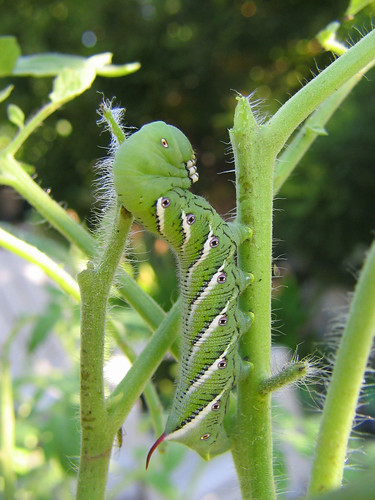
The Enemy -- Tomato Horn Worm

This is the evil tomato Horn Worm. He camouflages himself on your tomato plant and gnaws his way through the stalks, just when plump green tomatoes have begun feed the fantasy of having so many tomatoes you might even have to give some away. One morning you are lovingly watering your tomatoes, inspecting the blossoms, admiring the fruit, and sniffing the fragrant basil plants thriving in the same pot. Next day you come outside and the whole plant has keeled over...hacked to smithereens by something you'd swear has teeth.

But no, the culprit is not a squirrel, or a chipmunk or a deer. It's a green worm with horns that hides under the leaves of your plant, lays eggs and gets into the soil, so you've got to get rid of them, literally handpick them (UGH) out of the plant. The larvae blend in with the plant canopy, and therefore go unnoticed until most of the damage is done. Wasps are the horn worm's natural predator, but honestly, who would want to even attempt to catch and release a wasp.

The caterpillar reaches the final maturity in 3-4 weeks, and is 3 1/2 to 4 inches when fully mature. Fully-grown larvae then drop off of the plants and burrow into the soil to pupate. During the summer months, moths will emerge from pupae in about 2 weeks. Moths emerge from the soil, mate, and then begin to deposit the eggs of the next generation on tomato plants. By early fall, the pupae will remain in the soil all winter and emerge as a moth the following spring.

The horn worm likes nightshade plants and will also attack eggplant, pepper and potatoes. This is one hungry and vicious garden predator. Last Friday I bought two tomato plants to replace the ones my horn worm killed, and they were destroyed overnight before I even got them out of their peat pots! Tomato lovers beware.

Classic Tabbouleh

Yid.Dish: Classic Tabbouleh by Leah Koenig · June 29th, 2009
(Originally published on My Jewish Learning and cross-posted on Hazon’s blog The Jew & The Carrot, www.jcarrot.org)


I grew up eating my mother’s American tabbouleh–starchy, lemon-doused bulgur salad. This was the 1980s, when many American Jews were incorporating “Israeli-style” foods into their culinary repertoire. But while my mom’s tabbouleh was delicious, I later discovered that it hardly resembled the authentic version, which features a higher ratio of painstakingly chopped fresh parsley and tomatoes to grains of bulgur.

Tabbouleh, which comes from the Arabic word tabil (”to spice”), is not actually an Israeli or Jewish dish, per se. It originated in the Levant, the historic Middle Eastern region that encapsulated a large swath of land east of the Mediterranean Sea, including modern-day Israel along with Syria, Lebanon, the Palestinian territories, Jordan, and southern Turkey, among other countries. Like hummus and falafel, tabbouleh is tied to the broader region as opposed to one particular nationality or culture. Still, it has become an integral part of modern Israeli cuisine, most often served for summer lunches or as part of a salad course.


While bulgur is not traditionally tabbouleh’s star ingredient, it is, perhaps, the dish’s most defining component. An immediate relative of cracked wheat, bulgur is made from wheat berries that have been ground, partially cooked, and dried, making it a quick-cooking and relatively inexpensive base or addition to countless recipes (like these).
According to an article in the San Francisco Chronicle: “Archaeological finds in Greece and the Eastern Mediterranean suggest that people have been processing wheat into bulgur for millennia”–and the obsession continues today. The same article revealed that in the present day, Turks, who historically helped spread the grain’s popularity across the region, consume “about a half-pound of bulgur a week per capita.” Bulgur adds texture and substance to the otherwise all-vegetable tabbouleh, cutting the acidic lemon juice and tomatoes with its hearty, nutty flavor. In Israel, the dish is often served with pita bread, which aids in wiping up any excess juice, but there are other options, too.

According to cookbook author, Poopa Dweck, who authored, Aroma’s of Aleppo: The Legendary Cuisine of Syrian Jews, in old Aleppo, tabbouleh was served with romaine lettuce leaves. Tabbouleh can apparently also make people dance–but you’ll just have to try it and see.


Tabbouleh

Serves 8

3/4-1 cup fine bulgur soaked in hot water for 10-15 minutes, drained
5-6 Tablespoons good quality olive oil (do not skimp on quality–you will taste the difference)
juice of 3-4 medium lemons
2 teaspoons ground cumin

1 Tablespoon kosher salt

1 pint grape tomatoes, chopped
5 scallions, chopped 1 bunch fresh flat-leaf parsley, chopped one large handful fresh mint, chopped, plus extra for garnish

Combine the bulgur, olive oil, lemon, cumin, and salt in a bowl and let stand for 20-30 minutes while chopping vegetables. Add remaining ingredients and mix. Serve sprinkled with more fresh mint.