Tuesday, June 30, 2009

Fruit in Its Season

by Rabbi Rachel Kahn-Troster

Yesterday was the first day (finally!) of my local farmers’ market here in NJ, and I’ll admit I went a bit fruit happy, coming home loaded with local blueberries, strawberries, and cherries. It took some detective work to figure out what things were not local–the farmer may be Pennsylvania Dutch but those sure aren’t local peaches, not yet. I’m much stricter about eating fruit locally and seasonally than I am vegetables. I can go months without fresh berries or stone fruit, hoping that it counts towards my balanced diet if I eat many servings of fruit in the summer and far fewer in the winter. Sure, there are days towards late February when I am sick of citrus fruit, grapes, and bananas, and look longingly towards the plums flown in from California. But in my heart, I know they will disappoint me.

(As an aside, the Toronto Star had an article last week about the ubiquitous California strawberry, tracing it from laboratory to the store. The comments on the article are an interesting cross section of conflicting consumer values )

Today, choosing to eat seasonally is a values choice. In my brain, I hear two conversations from the days before I had my daughter. One parent explained to me that parenting is compromise, and that meant buying those strawberries in December if your kid just had to have them. Another told me how for her growing up, eating cherries was special, because you only got them for part of the year, and how she wanted her son to know that feeling of specialness when he eat cherries. I understand the first parent (we’ve all been there) but I want to be the second. Just because we can have something all the time doesn’t mean we should. We risk having the sacred and special become mundane.

Seasonal eating keeps us rooted in changes of every year, and that is what makes it such a Jewish value for me. Jewish time is agricultural, with the Pilgrimage festivals linked to the harvests of the year. The reason we have Jewish leap years is to prevent the holidays from coming unglued to the season: Passover can’t be in the middle of the winter and Sukkot can’t be in the summer. The rituals we associate with the festivals are also connected to the seasons: the spring greens on the seder plate, the first fruits of Shavuot, and the harvest decorations of Sukkot. There is some disconnection in the timeliness of it all for those of us who don’t live in Israel: every year, my father reminds us that the reason we eat potato at seder for our “spring greens” for karpas is that it was still winter in April in Poland. Our rootedness in the land is for a land far away, as we see when we pray for rain based on Israel’s climate calendar. And yet Jews all over have also adapted to the land they find themselves in, incorporating the seasonal produce of their new homes into their holiday meals.
Living according to the passage of the seasons also reminds us that we can’t have what we want all the time. I’m sure many kids would love it if every day were another night of Hanukah. But if we lit the candles all year, they would lose their meaning. They wouldn’t be special any more.

One of my teachers taught me that living on Jewish time means living on a separate clock and calendar than the rest of the world. To me, part of that means eating by the real calendar, not the artificial abundance created by technology and our ability to use fossil fuels to transport food. Food is a gift from God, and the more we take it’s permanence for granted, the more mundane we risk it becoming.

One of the traditional uses for the shehechiyanu blessing is the the first time you eat a fruit in a given season (or since Rosh Hashanah). Wouldn’t it be sad if we never had the chance to say it because our food was no longer linked to the seasons? As we head towards a beautiful summer of harvests, I hope we all have a chance to experience foods that are special.

Monday, June 29, 2009

Cool as a Cucumber

Nothing's better than cold soup in hot weather. Try these and others, from "Great Cold Soups"

Watermelon Soup

6 pounds seedless watermelon, diced
2 tablespoons chopped fresh mint
1 tablespoon sugar
2 tablespoons fresh lemon juice
1 cup lightly sweet white wine (such as Riesling)
1 teaspoon chopped ginger
8 teaspoons crumbled feta
1/4 cup sparkling wine (or sparkling water)

Combine 1 cup of the watermelon with mint and sugar in a bowl. Set aside. Blend remaining watermelon, lemon juice, wine, and ginger in a blender until smooth. Let sit 1/2 hour. Strain soup; divide among 8 bowls. Enjoy.

Spanish Gazpacho

4 ripe tomatoes
1/2 cup extra-virgin olive oil
2 ounces cider vinegar or sherry vinegar
2 cups tomato juice
1 cup diced stale or lightly toasted baguette bread
2 cucumbers, peeled, seeded, and chopped
1 red pepper, chopped
1 red onion, chopped
1 tablespoon minced garlic
1/2 bunch fresh parsley leaves, chopped
1/2 bunch fresh cilantro leaves, chopped
1 tablespoon minced jalapeno pepper, seeded (can substitute hot sauce)
Kosher salt
Sliced or diced avocado, for garnish

Bring salted water to a boil in a medium pot. Cut an "x" shape on the tops and bottoms of the tomatoes. Boil the tomatoes until the skin begins to peel back, about 20 to 30 seconds. Plunge the tomatoes into a bowl of iced water to chill. Peel and seed the tomatoes, then chop them. In a medium bowl, combine the olive oil, vinegar, and tomato juice. Mix well, and then add the diced bread to soak. In another bowl, combine the chopped tomato, cucumber, red pepper, onion, garlic, parsley, cilantro and jalapeno. Reserve 1/2 cup of this chopped mixture for garnish, if desired. Season, to taste, with salt. Put all ingredients into a blender or food processor and puree until smooth. Serve chilled and garnish as desired.


Zucchini & Watercress Soup

2 tablespoons unsalted butter
1/2 cup chopped yellow onion
1 teaspoon minced garlic
1 1/4 pounds zucchini, trimmed and chopped
1/2 teaspoon salt
1/4 teaspoon ground white pepper
3 cups vegetable stock
1 sprig thyme
1 cup packed watercress leaves (or cilantro)
1 tablespoon minced parsley leaves
1 cup heavy cream
1/4 cup creme fraiche or sour cream
Watercress sprigs, tough stems removed, garnish
Chopped chives, garnish

In a saucepan, melt the butter over medium-high heat. Add the onions and cook, stirring, for 3 minutes. Add the garlic and cook for 15 seconds. Add the zucchini, salt, and pepper, and cook until tender. Add the stock and thyme and bring to a boil. Reduce the heat and simmer, stirring occasionally, for 20 minutes. Add the watercress and let wilt, about 5 minutes. Remove from the heat and discard the thyme sprig. With a hand-held immersion blender or in batches in a food processor, purée the soup. Return to the heat and stir in the cream. Heat gently and cook for 5 minutes. Adjust the seasoning, to taste. Let cool and refrigerate until well chilled, at least 4 to 6 hours. To serve, pour into soup bowls or decorative cups. Swirl creme fraiche into each serving and garnish with watercress sprigs and chives.


Thursday, June 25, 2009

Go Green Expo

The Go Green Expo, coming to the Cobb Galleria Centre June 26 – 28 (June 26th is a Business to Business Day) is sponsored in part by WSB-TV, Go Green Expo will showcase the latest and greatest in all things green from fuel efficient cars and natural personal care products to greener gadgets that help us live more sustainably.

In addition to over 200 different exhibits, Go Green Expo will also host a variety of panels with leaders in the green industry, eco-celebrities, local politicians, and community activists.

Learn from speakers including: Oscar-nominated actress, model, eco-mom and author Mariel Hemingway, Atlanta Falcons fullback Ovie Mughelli, Atlanta eco-living expert Laura Turner Seydel, the Director of Sustainability for the City of Atlanta, Mandy Schmitt, the President of the US Green Building Council - Atlanta chapter, Ben Taube & many more!

People of the Bike

http://hazon.kintera.org/AccountTempFiles//account653/images/front.jpg
Learn More About the 2009 New York Jewish Environmental Bike Ride

This summer join Hazon on the 2009 New York Jewish Environmental Bike Ride! The Ride is two day retreat followed by a two-day bike ride, September 4-7, 2009.

The Retreat is a multi-generational and inclusive event. Learn, celebrate and relax at the beautiful Shabbat retreat, while enjoying kosher, local and organic food. If you think your CSA veggies are wonderful now, imagine the fresh from the farm produce in early September. The weekend is filled with educational and recreational programming for children, teens and adults. The Retreat is held at Camp Kinder Ring on majestic Sylvan Lake. Shabbat services are organized for every movement.

The NY Ride offers cycling routes for all cycling levels, from 30 to 100 miles. Fun for the whole family! You will experience a beautiful, scenic route in the Hudson Valley of New York, with fully supported bike mechanics, rest stops, and luggage transportation.

Registration is $399. This includes all your meals, lodging, luggage transfer, snacks, bike and medical support and a weekend filled with environmental programming. All participants have a fundraising minimum.

The money raised from the bike ride will go to support a wide range of outstanding and innovative programs in the U.S. and in Israel, such as Hazon’s Community Supported Agriculture (CSA) programs in North America, and the Arava Institute for Environmental Studies, a premier environmental teaching and research program in the Middle East that brings together Jewish and Arab students.

This ride will provide you with a physical challenge, an empowering experience and a welcoming and warm Jewish community. Join The People of the Bike! Register now at www.newyorkride.org.

Top 10 CSA Kitchen "Must Haves"

http://jcarrot.org/wp-content/uploads/veggies2.jpg
The wonderful Tuv Ha’Aretz Community-Supported Agriculture group at the JCC Houston came up with this Top-10 list of must have kitchen items in order to maximize the produce from your CSA share. Turns out, the list is pretty handy for any Jewish food enthusiast - feel free to share with friends and family.

Top 10 CSA (& Jewish Food) Must Haves
1. Evert-Fresh Green Bags - The best bags for storing fruits and vegetables. Possibly ever?
2. Slow Cooker - Slow cook your veggies into a delicious Shabbat dinner (or lunch!)
3. Salad Spinner - A handy salad spinner makes your weekly influx of lettuce and leafy greens a snap to clean - or at least a lot easier.
4. Freezer Bags - Freeze those fresh, local corn kernels to enjoy all winter long.
5. Food Processor - Pesto, butternut squash puree, homemade soup…mmmmm
6. A Food Steamer - Steam your raw veggies into a delicious dinner in no time.
7. An (Immersion) Hand Blender - The best thing to happen to soups since the spoon.
8. An Ice Cube Tray - For freezing that pesto (or tomato sauce, butternut squash puree…) into easy-to-store-and-reheat cubes.
9. Space to put everything (yes, this can even be done in the city!)
10. A Large Stock Pot - For soups, sauces, boiling pasta…you can never have enough big pots around.

Tuesday, June 23, 2009

Jewish Food Jewish Life: Practicality vs. Deliciousness

By Eve Quarrendon Jochnowitz
Member Tuv Ha’Aretz Hazon CSA at the 14th Street Y in New York City

In this week’s (6/20/09) sedre, shelakh-lekha we read the famous story of the spies sent by Moses to reconnoiter the land of Israel. The accounts brought back are not contradictory but they highlight two very different but equally accurate views of the situation: first, that it is unlikely that a rag-tag group of desert-bedraggled wanderers could overthrow an entrenched military power, and second, the produce there is just so good, you have to try it! The Israelites faced with the two reports contemplate a seemingly impossible undertaking that might yield up some really good food. In a way, this story is the mirror image of the episode in last week’s parshe, in which the flavorful vegetables of Egypt are remembered in the context of the seemingly endless and impossible sojourn in the desert.

But challenging undertakings are by no means as impossible or impractical as they seem before you try. It is hard to believe now, but people my age will recall that for decades organic agriculture was dismissed as impractical, inefficient, and an actual threat to the world food supply because of lower yield. The opposite has proved to be the case as the careful land-management by organic farmers like our CSA partners has in fact resulted in more food (and vastly more delicious food) produced on sustainably cultivated land.
The giant, fat, juicy, fragrant, and irresistible grapes carried back by the spies tell their story more eloquently than any words: Strive for deliciousness and accomplish the impossible.

Friday, June 19, 2009

CSA Slaw

This tangy coleslaw comes right out of the Shearith weekly CSA box:

1 small head of green or red cabbage . . . or 1/2 of both!
3 large red radishes
3/4 cup baby carrots (any kind of carrots are fine)
1/2 tsp. salt
1/2 tsp. pepper
3/4 cup mayonnaise
1 Tb. dijon mustard
A splash of white vinegar

Slice the cabbage as fine as possible, cutting out the center core
Cut the radish and carrots into smaller chunks and pulse in food processor until chunky
Combine cabbage with radish and carrots
Mix salt, pepper, mayo, mustard and vinegar in a bowl
Add to cabbage mixture and fold in until everything is well mixed
Chill and serve.
Other nice add-ins: parsley, green pepper, scallions, onions, etc.
Feeds 4-6

Wednesday, June 17, 2009

This Week's Box. This Week's News.

What's in this week's box?
onions
cabbage (red and green)
summer squash
kohlrabi
cilantro
lettuce
bok choy


Fresh...the Movie

We are hoping to bring the acclaimed film FRESH to Shearith Israel for viewing on a Wednesday night in July.

FRESH celebrates the farmers, thinkers and business people across America who are re-inventing our food system. Each has witnessed the rapid transformation of our agriculture into an industrial model, and confronted the consequences: food contamination, environmental pollution, depletion of natural resources, and morbid obesity. Forging healthier, sustainable alternatives, they offer a practical vision for a future of our food and our planet.

Among several main characters, FRESH features urban farmer and activist, Will Allen, the recipient of MacArthur’s 2008 Genius Award; sustainable farmer and entrepreneur, Joel Salatin, made famous by Michael Pollan’s book, The Omnivore’s Dilemma; and supermarket owner, David Ball, challenging our Wal-Mart dominated economy. Take a look at the trailer.


Monday, June 15, 2009

Newsflash - The Queen Will Have An Organic Garden Too

According to Obama Foodorama, Queen Elizabeth is putting in a veggie garden too!

In what can only be regarded as an excellent and perhaps amazing turn of events, Her Majesty Queen Elizabeth II has planted a vegetable garden at Buckingham Palace--and it may well have been inspired by First Lady Michelle Obama, who visited The Queen with president Obama during the G20 Summit. The new 30ft x 12ft palace vegetable garden, called "The Yard Bed," is the first food garden on royal grounds since there was a Victory Garden planted in World War II, even though there are about forty acres of gardens at the London compound. (Above: The Queen, Prince Phillip, and gardener Claire Midgley survey the new garden)

Read the rest here.

Sunday, June 14, 2009

Another Radish Recipe

Radish Dip
from Louise Spiro

8 ounces cream cheese
1/4 cup margarine
1/4 teaspoon celery salt
dash paprika
1/2 teaspoon Worcestershire sauce
1 cup finely chopped radishes
1/4 cup finely chopped green onion
Combine all the ingredients
Chill and serve with crackers or vegetables

Friday, June 12, 2009

Rethinking radishes

By Barbara Damrosch
Published Thursday, April 7, 2009 in The Washington Post

Crisp, crunchy, tangy, zippy, zesty, snappy, peppy, pungent, piquant and sparkly. These are some of the adjectives that the United Fresh Fruit and Vegetable Association, in a 1977 pamphlet, proposed to radish growers for marketing their product. Radishes "give zing to salads," the association wrote.

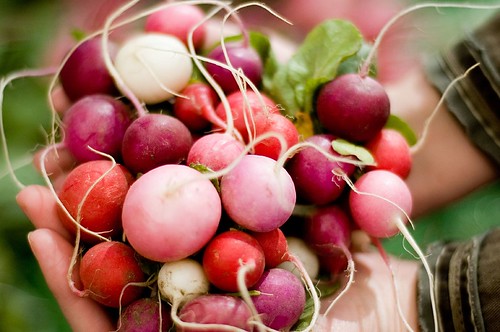
Well grown and well displayed, radishes sell themselves. I think of exquisite, bunched French Breakfast radishes heaped high in an outdoor market stall, their leaves a healthy green, their small, red, white-tipped cylindrical roots firm and inviting. No need to label them "piquant." But cooks aren't always familiar with the full range of radish types, beyond the little red balls served at Thanksgiving. Some are hard to come by unless you grow your own.

As a gardener-cook in search of a radish education, you might begin with the Baker Creek catalogue, which lists 24 diverse varieties from many lands. You'll learn that there are quick-growing spring radishes, which can be planted right now, and larger winter ones best sown from late summer on, with cool temperatures ahead. (Hot days produce hot radishes with pithy centers, especially if left in the ground too long.) For spring you might try Helios, a bright yellow, olive-shaped radish from Slovakia. Saxa 2, a small, round red one, matures in a mere 21 days. Small weekly plantings would give you a steady supply.

Winter radishes to buy now, plant later include Chinese Green Luobo, much like a daikon with green flesh. Consider the crisp and pungent Long Black Spanish and the deep purple, 10-inch French heirloom Violet de Gournay. Or Philadelphia White Box, "perfect for growing in cold frames over winter," according to Baker Creek. My first choice would be Chinese Red Meat, one of the ancient Beauty Heart types, also called watermelon radish. The round roots, up to four inches across, seem drab at first look, but slice one open and you'll find brilliant magenta color in a radiating starburst pattern.

Whichever radishes you select, give them plenty of moisture. Though a loamy soil is ideal, even clay-soil gardeners can succeed, because radishes tend to shoulder their way upward as they grow.

Plant a radish and you'll get a far more versatile ingredient than you might think. Try sauteeing them, grating them for sauces or adding them to soups, stews and vegetable purees. Cooked radishes lose their bite but not their earthy brassica flavor. Use the tops as you would turnip greens. If they go to seed, put the peppery young pods in salads. For sheer drama, slice disks of Beauty Hearts into a stir-fry, cooking only briefly to retain some crunch. Or serve them raw -- as a dip vehicle perhaps -- if, for you, a radish must have tang, pep and zip.

Wednesday, June 10, 2009

A New Newsletter

It's a fresh new start for our Shearith Israel CSA newsletter. We hope this new blog format will make it easier to bring you news and recipes and stories from the tables, kitchens and gardens of our members.

Squishy strawberries notwithstanding, the quality of our produce from Riverview Farms has been excellent. We are hearing some gripes about the amount of time it takes to process the weekly harvest. When you're used to greens that are washed and poly-bagged, or onions that come without "tails" it can be a bit of a shock to rinse, sort, and trim your vegetables.

We highly recommend resuable Debbie Meyer green bags, as a storage solution for your washed and prepped produce.
They work by absorbing and removing the ethylene gas that fruits, vegetables and flowers release while ripening after harvesting or picking. The Green Bags dramatically extend the life of fruits, vegetables and flowers. You can buy them online, at Target or Bed Bath & Beyond.

A Most Unusual Salsa

Cherries are in the stores. And our CSA boxes have been full of onions. Here's an unusual salsa that combines the two:

Cherry and Spring Onion Salsa
Adapted from Samin Nosrat, from the New York Times

Time: 15 minutes

1 small red spring onion bulb and greens

3 tablespoons lemon juice, or more to taste

1 1/2 cups pitted cherries, or about 8 ounces

1 teaspoon finely chopped chives

1 tablespoon finely chopped parsley

1 small jalapeño, seeded and finely chopped

5 tablespoons extra virgin olive oil

1/2 teaspoon kosher salt.

1. Finely dice spring onion bulb and greens. Place 3 tablespoons diced bulb and 1 tablespoon greens in a small bowl and pour lemon juice over them. Set aside for 10 minutes to macerate.

2. Halve the cherries and slice into slivers. Place cherries, herbs, jalapeño, olive oil and salt in a medium-size bowl and stir to combine.

3. Add onion and greens, taste and add more salt and lemon juice if needed.

4. Let the salsa sit for at least 5 minutes to meld flavors.

Yield: 4 to 8 servings.

Note: Salsa can be spooned over flaky fish, like halibut, or grilled pork or duck.